What is The Unit Circle?
The unit circle is a clever visual tool that can be used to analyze various aspects of trigonometry. First of all, it’s a circle. And while you may be most familiar with thinking of trigonometric functions in the context of right triangles, they can actually be thought of as parts of a circle. One of the limitations of thinking of trigonometric ratios solely from the perspective of right triangles is that the angles on a right triangle are restricted to be between zero and ninety degrees (0 to pi radians). However, the trigonometric functions are defined well outside this domain. Thinking of the trigonometric functions in the context of a circle allows you to analyze trigonometric relationships for any angle. Also, the definitions of the trigonometric functions in the context of right triangles naturally extends to their analysis as being part of a circle. In other words, you don’t have to relearn anything you know about trigonometry and right triangles to make sense of the unit circle approach to trigonometry. You just have to be able to expand your view to accommodate more possibilities. Everything you know about trigonometry using right triangles is still true on the unit circle. The unit circle just extends this analysis even further. What we’ll talk about in this article is specifically how to map your knowledge of trigonometry using right triangles onto the unit circle in order to take advantage of its greater capabilities in understanding trigonometry.
The “unit” part of the unit circle has a specific meaning. Typically, any time you hear or see the word “unit” in the context of mathematics, it means 1. For instance, in more advanced math using vectors, you’ll hear the term “unit vector” which means a vector with a length of 1. So what about the unit circle is 1? Its radius is 1. As we’ll see when we’re mapping our right triangles onto the unit circle, the hypotenuses of these right triangles will be the same length of the radius of the circle.
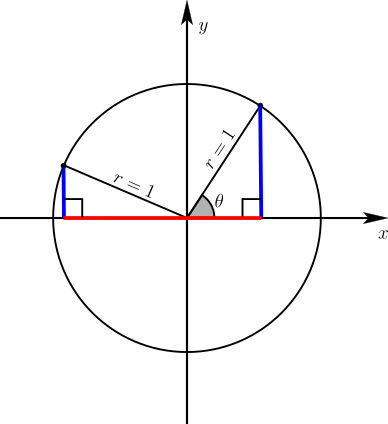
To analyze the trigonometry on a unit circle, the x and y coordinates of the points on (and sometimes off) of the circle are important. Therefore, this unit circle doesn’t mean anything without a relevant coordinate system. The location of the unit circle in the x-y plane is such that its center is at the origin. So to summarize, the unit circle is a circle with radius 1 centered at the origin of the x-y plane.
How does the unit circle work in explaining trigonometric functions?
The basic principles allowing the unit circle to be used for analysis of trigonometric functions are few and simple. Here they are:
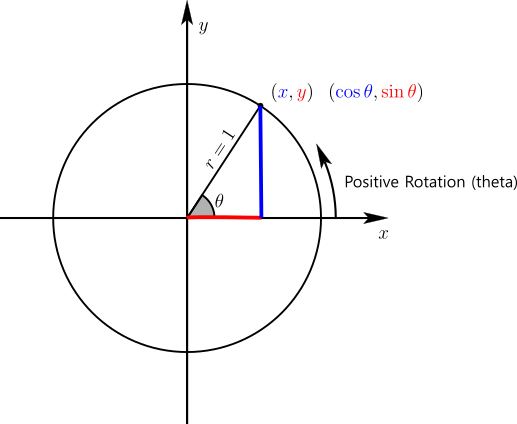
- Angles are measured from the positive x-axis. Counter-clockwise rotations are positive angle changes. Clockwise rotations are negative angle changes.
- The x-value of a point on the circle is equivalent to cosine of the angle formed by the radius that extends out to that point and the positive x-axis
- The y-value of a point of the circle is equivalent to sine of the angle formed by the radius that extends out to that point and the positive x-axis
This can be shown with a simple diagram:
From these simple basic principles (along with all the analytical trigonometry you know), the unit circle can be used to analyze complicated problems involving trigonometry.
Basic Trends that Emerge from the Unit Circle
Because the x values of the points on the unit circle are the values of cosine of the corresponding angle and the y values of the points on the circle are the values of sine of the corresponding angle, we can see pretty easily the quadrants in which cosine and sine are negative and positive. This is summarized in the following figure:
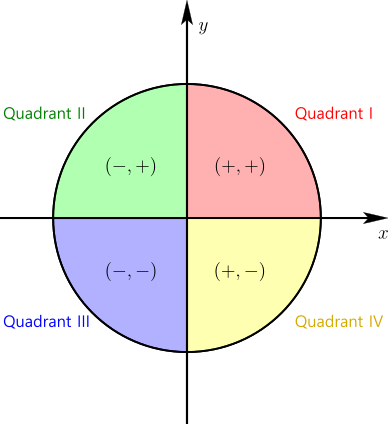
This all comes from the idea that is x and is y. In the first quadrant, and are both positive. Why? Because x and y are both positive in the first quadrant. In the second quadrant, is negative and is positive. Why? Because x is negative and y is positive in the second quadrant.
Knowing the signs of and at different angles allows you to immediately determine the signs of the other 4 trigonometric functions for that value of . For instance, we know from the reciprocal identities that . Therefore, we know that any angle where and have the same sign, will be positive (the first and third quadrants). And any angle where signs of and have different signs, will be negative (second and fourth quadrants).
Some other trends that we should notice is how the two functions and change as the angle changes. We can determine this at a general level by just looking at the unit circle. Let’s start by looking at a specific angle. Let’s look at . This corresponds to the point on the following diagram of the unit circle.
Now we need to just ask ourselves, as increases (we rotate counterclockwise from this point), what happens to the x and y values on the circle? Well, you should notice that the x value doesn’t change that much when you change the value of a little bit. However, the value of y changes a lot when you change the value of a little bit. So around the value , changes very slowly and changes relatively quickly.
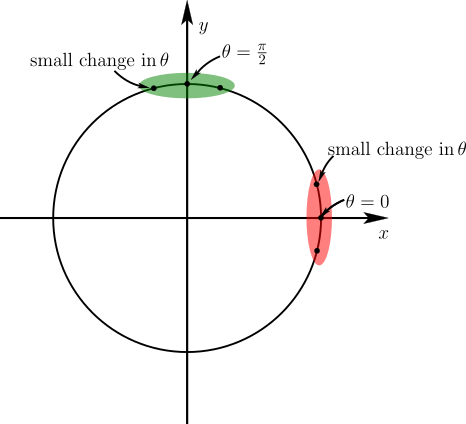
But how are the functions changing when it comes to their values? Well we can look at the unit circle again and determine the answer. As we rotate around circle counterclockwise, the value of decreases from its maximum value of 1 (the x value of the points on the unit circle decrease from the maximum value of 1), and the value of increases from 0 (the y value of the points on the unit circle increase from their value of 0). Once we hit the angle of , the trend changes a little bit. Now we’re at the top of the circle and the value of or x is changing fast (we’re basically moving horizontally for a moment at the top of the circle) and the value of or y is changing slowly (again, because we’re basically moving horizontally, the y-values don’t change very quickly). Also, let’s again look at how their values are actually changing. is still decreasing (as you rotate around the counterclockwise direction at the top of the circle, the x-values are still decreasing) and it actually becomes negative, and actually starts decreasing as well from a maximum value of 1 (the y-values are at their largest, and start to decrease from 1 as you continue to rotate around the circle). We can continue to analyze these trends around the circle. This will be very useful when we look at how to determine the wave graphs of later.
What specific values are you supposed to know on the unit circle?
So this is the main reason you need to know the unit circle. Other than the trends and behavior that the unit circle reveals about trigonometric functions, there are specific values of and (x and y) that you need to know for specific angles. Here is the full annotated unit circle with all of the values you need to know. At first, it looks daunting. But we’ll see in a moment that you only really need to know a few of these points and angles in order to be able to figure out the rest due to some of the symmetries that exist in circles.
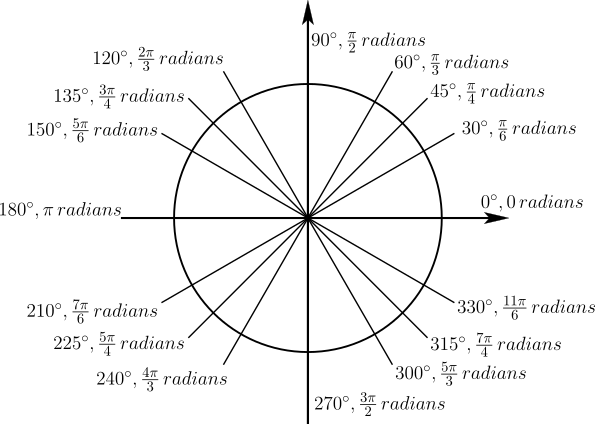
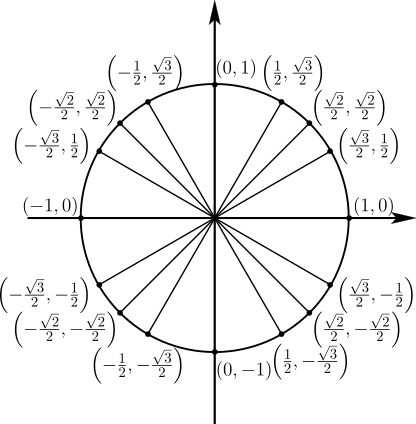
So these are all of the angles and points you need to know on the unit circle. It seems pretty daunting at first, but there are actually quite a few patterns we can observe. In fact, you only need to know the angles and ordered pairs in the first quadrant. From there, you can take advantage of all the symmetries of the circle to fully annotate all four quadrants. So let’s just look in depth at the first quadrant. Which angles do we need to know? From the diagram that includes the angles, we can see that we need to know the values of and for , , , , and . You just need to memorize the angles. One way to remember these angles is to realize they account for the that forms the first quadrant broken up into thirds (, , , and ) and halves (, , and ).
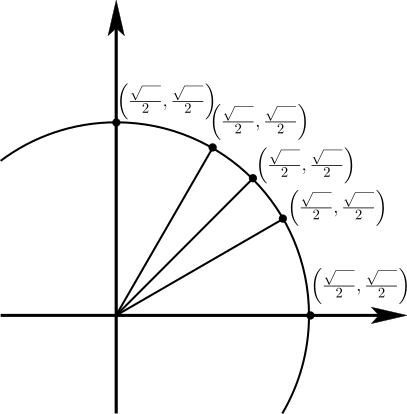
Now how do we remember the values of x and y (and therefore cosine and sine) for these angle values? There is actually a nice pattern that emerges in the numbers. Don’t ask me why this pattern exists. I have no idea why this interesting pattern emerges. It’s just something I’ve noticed that can help you remember the values you need to know in the first quadrant. First think of all of the values of x and y on the circle as square root of something divided by 2. You can see what I mean in the following figure:
Now, let’s start filling these in. Inside every square root goes either a 0, 1, 2, 3, or 4. Let’s start with the point at angle 0 radians (the point that’s on the x-axis). What goes inside the square roots for the x and y? In the x-value, we’ll need to put a 4 inside the square root, and for the y-value, we’ll need to put a 0 inside the square root. But how does this make sense? Well, what is the x-value at that point? It should be 1. Remember, this is the unit circle centered at the origin with a radius of 1. Therefore, that point that is one full radius in the x-direction from the center would have an x-value of 1 plus the x-value of the center of the circle. Because the x-value of the center of the circle is 0, the x-value of this point is 1. So why did we put in 4? It’s because that’s inside a square root. The square root of 4 is 2, and 2 divided by 2 gives us the ultimate x-value of 1 that we know that needs to be. So that’s why the x-value of this point is . Now what about the y-value? Well, that’s obviously 0 at this point. It’s the same y-value as the center of the circle because we didn’t move up or down from the center. We just moved left or right. So what do we need to put inside the square root to make the total value 0? That would be 0 because . So let’s put these points in the first quadrant of the unit circle.
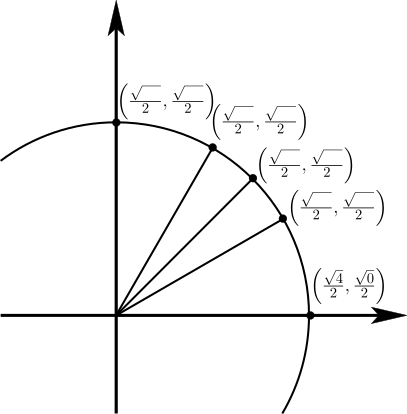
So now that we have the “first point” set, the pattern that emerges is that we just lower the value of the number inside the square root for the x-values by 1 at each new point as we rotate counter clockwise, and we just raise the value of the number inside the square root for the y-values by 1 at each new point as we rotate counter clockwise.
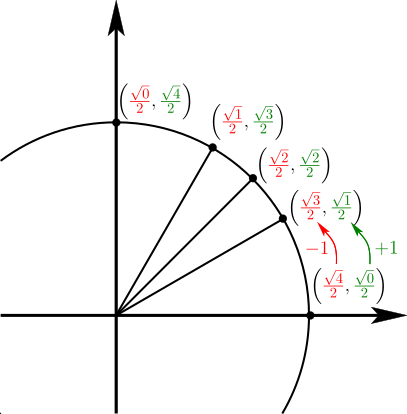
Now let’s just simplify these values:
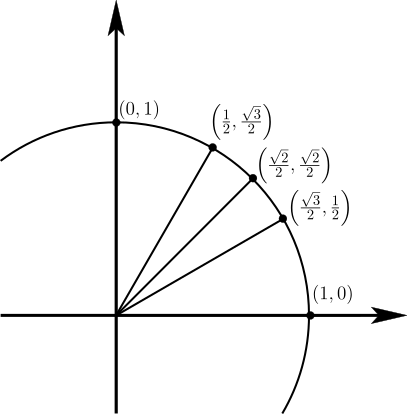
So now we have the entire first quadrant filled out. How do we get the x and y values () for all the other points on the circle? Well, we can take advantage of the symmetry of the circle and notice that all of the other points are just transformations of the points we already have. Let’s take a look at the second quadrant. Theses are all the same x and y values, but the x values are negative because it’s like we’ve flipped the second quadrant across the y-axis without moving up or down. That causes the x-values of the points to be the opposite sign.
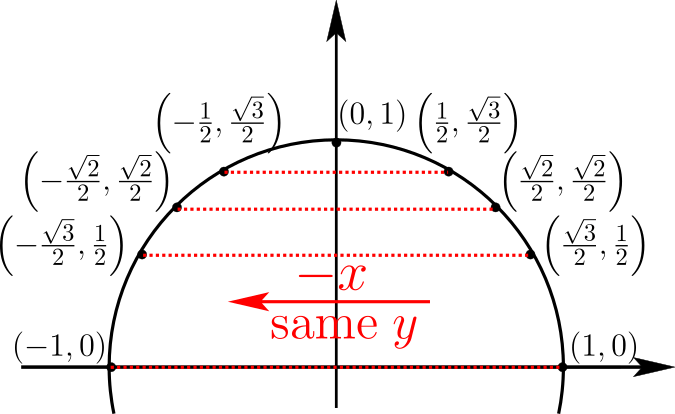
Now we have all of the points in the first and second quadrant. How do we get the rest of the points in the third and fourth quadrant? Well we can notice that due to the symmetry of the circle, the points on the bottom half (the third and fourth quadrants) are reflections of the points in the top half across the x-axis. This transformation just keeps all the x-values the same, but negates all of the y-values.
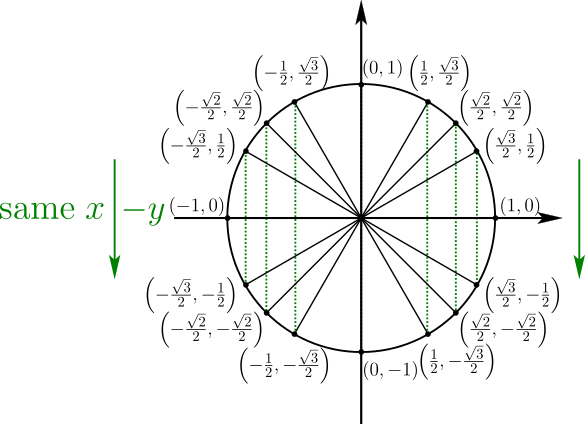
Now we have the full unit circle filled out with all of the important points labeled. This was all based on a simple pattern that we notice in the first quadrant and the fact that the other quadrants are the same points as the first quadrant just reflected across the different axes. We can now use this information to answer questions and solve problems involving trigonometry. We’ll look at that in the next blog post.
Summary
In summary, the unit circle is a useful tool to visualize the trigonometric functions and and their behaviors as the angle changes. The unit circle is a circle centered at the origin with a radius of 1. In this context, the angle is defined as the angle created from an initial side on the positive x-axis where positive values of are created by rotating counter clockwise, and negative values are created by rotating clockwise from the positive x-axis. On the unit circle, the x-coordinate is and the y-coordinate is . Taking advantage of various symmetries of the circle, we can transpose and transform points around to find the values of and for various angles.

