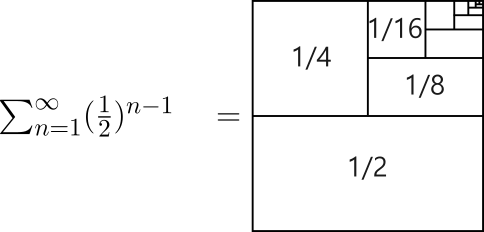
What are Sequences and Series?
Sequences and series are topics covered near the end of a Calculus 2 class, but show up in all kinds of situations. Let’s discuss what these two concepts mean in a little bit of detail. A sequence is just an ordered list of numbers or terms. For instance, the following would be considered a sequence:
In this sequence, the numbers in the sequence can be thought of as the output from a function, or the y-values. So what are the x-values? The x-values are the positions that the numbers take in the sequence. Looking back at the previous sequence, we can see that the 3rd number in the sequence is a 5. Therefore, you can think of this sequence as a function where it takes an input of 3 and produces an output of 5. The “position” we keep referring to is called an “index”.
Many sequences of interest can be written as a mathematical expression that illustrates how the index becomes the sequence value (exactly how most functions are written as mathematical equations that detail how each input in the domain becomes each output in the range). Let’s try to come up with the mathematical relationship that maps the indices to the terms in the sequence. If you notice, the terms in the sequence are just the odd integers from 1 up to 13. So what mathematical expression, if any, would turn 1 into 1, 2 into 3, 3 into 5, 4 into 7, and so on? Well first, let’s pretend that the numbers in the sequence were the even integers. How would we turn 1 into 2, 2 into 4, 3 into 6, and so on? That’s a much easier relationship. You just double the index, and now you have the even integers. So how do we get the odd integers? Easy, just subtract 1 after you double the indices. This can be summarized in the following equation:
This means that we have a sequence with the formula inside the curly brackets with an index that starts at 1 and ends at 7. In other words, we have 7 terms in our sequence (1 through 7) and to get the number at the nth index, you do the math inside the curly brackets. So how is this different from the function:
These look like they’re saying the same thing to me. Well, they’re not because it really comes down to the difference between the variable and the variable . Remember that the variable n represents the index. That means that it represents the place that the associated term takes in the ordered list of terms that make up the series. So the “domain” of a series can only ever be integers since they represent the position of the terms in the list. However, the variable x is assumed to be a continuous variable. Therefore, in the previous function, x can take any value from 1 to 7 including decimals and fractions and anything else you can think of. This would be clear from the graphs of the sequence vs. the corresponding function. The graph of the sequence would only consist of 7 points. There would be a point at (1, 1), (2, 3), (3, 5), and so on, but there would be nothing in between since there is no index or position in the list of numbers between 1 and 2 or 2 and 3 and so on. The graph of the corresponding function would consist of a solid curve (a line in this case) defined by the function . But the curve would go through all the same points defined by the sequence if you think of the values of n as x-values and the sequence values as y-values. So in a lot of ways, sequences are like functions with the condition that the input variable can only be integers within a certain domain.
In a Calculus 2 class, you’ll be mostly interested in sequences that have infinite terms. So the ordered list of terms or numbers is infinitely long without end. In this situation, we would be interested to know if the sequence converges or diverges. In this context, that just means that the numbers or terms that form the sequence start to approach a single value or term as you proceed infinitely down the list of numbers. This should sound familiar. I’m describing a limit. Therefore, to determine whether or not a sequence converges, we just need to find the value of the following limit:
If this limit has a value, then the sequence converges. If this limit does not have a value (either because the value of the limit is or the values in the limit do not go to a specific number as you go infinitely far down the positions in the sequence), we would say that the sequence diverges. That’s all you have to know when it comes to sequences. Whether or not they converge or diverge only comes down to the value of the limit and whether or not it exists. One concept or idea that you will need to brush up on is how to evaluate limits at infinity.
So we’ve been talking a lot about sequences so far and haven’t discussed anything about series yet. Are they the same thing? No. They’re similar, but they’re not the same. In fact, a series is just the sum of the terms in a sequence. That’s it. If you have a sequence and you add all the terms in the sequence together, you now have the corresponding series. With series, we’ll primarily be interested in those series that come from the summation of an infinite sequence. To determine whether a series converges or diverges, we’ll need to determine whether the sum of an infinite number of things adds up to a single number or if it does not. This is a much more difficult question to try and answer. There are many different convergence and divergence tests that are designed to determine whether or not a series converges. Just like solving an integral requires knowing certain integration techniques and when to use them, determining whether a series converges or not requires knowing certain convergence and divergence tests and when to use them.
Some Basic Types of Series and Convergence/Divergence Tests
For the rest of this blog post, we’ll look at some qualities and behaviors of series, discuss some common series you should know, and finally introduce some of the simplest convergence and divergence tests for series. First, let’s dive into the apparent contradiction of an infinite series. For an infinite series, we’re interested in whether it converges or not. This means we are interested in whether you get a specific number when you add up an infinite number of numbers. Why do we even need convergence and divergence tests for series? It seems like they would never converge, right? How in the world can you add up an infinite number of numbers and not get infinity or negative infinity? The answer is if the terms eventually become zero or if they shrink towards zero at a certain rate as you progress down the sequence of numbers your adding, the sum can be a finite amount. You’ve actually seen this before. In the context of the definite integral, we saw that you can add up an infinite number of things (rectangular slices of the region bounded by a curve) as long as the terms get smaller at a certain rate with the number of things that you’re adding.
Nth Term Divergence Test
So that actually brings us to our first type of convergence/divergence test. It is called the Nth Term Test for Divergence. This test is basically mathematically equivalent to the only convergence/divergence test we needed for sequences:
For a sequence, the result of this limit tells us whether or not the terms in the sequence eventually tend toward a certain value or not as you progress infinitely far down the ordered list of terms. So how is this useful information for the infinite sum ? Well, what this limit literally tells us is what the numbers in the list of numbers we’re adding together start to become as you go infinitely far down the list. What would these numbers have to eventually converge to if the infinite sum has even a chance of converging? The answer is 0. If the infinite sum of numbers has even the slightest chance of adding up to a finite amount, the terms in the sequence would eventually have to start to become infinitesimally close to 0. That’s the basic idea of the Nth Term Test for Divergence. So what we can conclude is that if the numbers in the infinite sequence that we’re adding together to form the infinite series (or sum) DO NOT eventually get infinitesimally close to 0, then the series has no chance of converging, and we can conclude that it diverges.
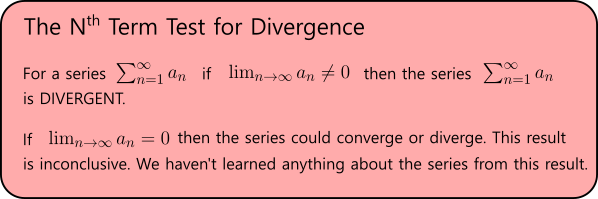
Let’s look at what this Nth Term Test for Divergence is saying. Basically, it says that if the terms in the series do not eventually get indistinguishably close to zero, we can conclude that the series diverges. This should make perfect sense. What would happen if you added up an infinitely long list of numbers (an infinite sequence), and the numbers in the list don’t become super close to 0? Then the sum would either add up to infinity or negative infinity, or the sum would not add up to anything specific. Either way, the series would not sum to a single finite amount. But let’s look at the other result. What if the numbers in the sequence your summing to form the series do eventually get down infinitesimally close to 0? Well that sounds like the series would have to converge since you’re eventually adding 0 over and over again forever, right? At this point our simple logic is starting to break down. We’ll prove this later, but for right now, just take my word for it that just because the numbers do eventually get down infinitesimally close to 0, that may not be enough. If the terms do eventually get down infinitesimally close to 0, you need to analyze the rate at which they get down close to 0. If you want to understand how it is possible for a series with terms whose limit as n approaches infinity is zero to not converge, think of a corresponding improper integral with an infinite upper bound for the limit of integration. If the function your integrating eventually gets down infinitesimally close to 0, that means the height of the region whose area you’re finding with that integral is getting infinitesimally close to 0. Doesn’t that mean that the area has to be a finite amount? Well, calculate the following integral, and you’ll see that just because the function that defines the height of the region eventually becomes infinitesimally small, that doesn’t mean that the area of the bounded region converges:
In fact, if you can make the connection between infinite series and their corresponding improper integrals, you can better understand the next convergence/divergence test that you’ll probably learn in class called The Integral Test. We’ll talk about that in a later post.
Partial Sums
One way that we can determine whether a series converges or diverges is to convert it to a sequence of partial sums and investigate if that sequence converges or not. Partial sums are just a running total of the total sum as you add one term to the previous term. These are generally denoted as .
For the series
We can show the partial sums as
In other words, the mth partial sum is just the first “m” terms in the corresponding sequence added together. Let’s look at some of the math involved and how these partial sums reveal what’s going on with the infinite series. First, we should notice that the m+1st partial sum is just the mth partial sum plus the next term in the series .
So if we define a new sequence where or the mth partial sum, the result of the convergence of this SEQUENCE of partial sums would be the result of the convergence of the corresponding infinite SERIES. So if we can come up with a formula for the mth partial sum of a series, we could then determine the convergence or divergence of that corresponding sequence of partial sums and determine if the series converges or diverges. This brings us to two specific types of series for which you can determine a formula for the corresponding sequence of partial sums.
Telescoping Series
A telescoping series is a series in which most of the terms end up adding up to zero such that a large sum can really be calculated by adding only a small number of the total terms. Something that “telescopes” in real life is like the hydraulic cylinder in the following picture. It is composed of concentric tubes that can extend out to form one long tube, or these concentric tubes can be collapsed down to a smaller form:

If I could rename what a Telescoping Series is, I may rename it to a Collapsible Series because that’s really the behavior these types of series exhibit that make them interesting. Let’s see what this type of series looks like in action. Take the following series:
Let’s now take a look at the partial sums:
Notice a pattern yet? What if I asked you to write out the formula for the mth partial sum ?
The pattern is that there is always the first positive term that remains and there is one negative term that remains at the end. So now we have a formula to find the mth partial sum. What can we do with that? We can determine the convergence of the infinite sequence of partial sums to determine the convergence of the corresponding series. So now we’re back to analyzing a sequence. We just have to investigate the limit as m approaches infinity:
Therefore, we now know that this telescopic series converges to 1 because the sequence of partial sums converges to 1.
Geometric Series
A geometric series is another type of series where we’re able to come up with a formula for the sequence of partial sums. But what even is a geometric series? Geometric series are related to exponential functions. In a geometric series, the next term that you add to the previous partial sum to get the new partial sum is always the same number multiplied to the previous term:
This multiplier is called the common ratio “r”. This is similar to an exponential function where every time you increase x by 1, the new function value is the the same number times the function value before it:
Therefore:
Because of this behavior, a geometric series can be written in this general form:
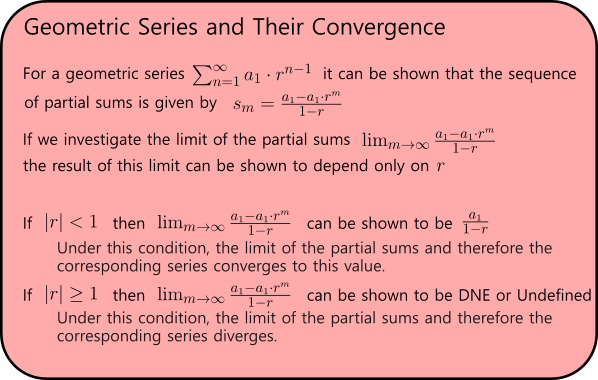
From this relationship, the following properties can be derived for a geometric series. Hopefully, proofs for these properties were offered in class or in your notes. If not, we can go through them in a later post. But for now, take my word that the following is true:
So now let’s see this in action with an example of a geometric series. Let’s take the series:
Now this doesn’t look like the exact form of a geometric series that we discussed before (). However, if every next term in the sequence of numbers is the same multiplier of the previous term, then it is geometric no matter what the formula looks like. Let’s see how we can determine this.
Now do you see that we took an arbitrary term and divided it by the previous term without specifying what n is, and it still ended up where all the n’s divided out? Because we found that the value of any term divided by the previous term without specifying which specific term we’re referring to reduces to a constant ratio ( in this case), this proves that the series is geometric. So not only do we now know that this series is a geometric series, we can also determine if it is convergent or not because we determined the value of the common ratio in the process of determining whether or not it was geometric, and the convergence or divergence of a geometric series only depends on the value of this common ratio. So we just ask ourselves, is the absolute value of the common ratio less than 1 or is it greater than or equal to 1? Since is less than 1, we know that this geometric series will converge.
But we can do better than that. Remember, for a geometric series (like a telescoping series), we actually have a formula for the partial sums. We therefore know that because the series converges, it will specifically converge to . We know , but do we know ? Well, if you try to compare our geometric series with the formula for a geometric series that lists out , you’d be tempted to say that is probably 15, right? Well it’s actually not. And the reason why is because what really represents is the first term in the geometric series. In our geometric series, I can tell you that the first term is not 15. So what is it? We can figure it out by just substituting 1 in for n and that will produce the value of .
Therefore, the actual sum of the series is which simplifies to .
Summary
In summary, a sequence is an ordered list of numbers which you can think of like a function. What you input is the position of the number in the list, and what you get out of the function is the number that goes in that position. To determine whether or not a sequence converges, there is only one test. You determine the limit of the function that defines the sequence as the value of the index goes to infinity. If this limit exists, the sequence converges to that value. If the limit does not exist, the sequence diverges.
Series are much more complicated. A series is the sum of a sequence. A series converges if the sum of the infinite sequence it represents is a single finite amount. If the sum of the infinite sequence is not a single finite amount (either because it’s not a single determinant amount, or if it’s not finite), then the series diverges. But to prove if an infinite sum converges or not requires you to be much more clever. There are lots of different convergence and divergence tests for series. The most basic one we talked about in this post is the Nth Term Test for Divergence which operates on a simple principle. If the terms in the sequence that form the series never approach 0, then the sum cannot be a specific finite amount. However, if the terms in the sequence that form the series do approach 0, that leads to an inconclusive result. The series could converge or diverge still.
By looking at the sequence of partial sums, we can determine if the infinite sum is approaching a single value or not. We discussed two types of series for which you can determine a formula for their partial sums: a telescoping series and a geometric series. By understanding what these two series are and how they behave, we can easily determine whether or not they converge and what they converge too. This is a very important distinction between these types of series and most of the other series that you come across. For most series, you will not be able to determine what they converge to specifically. You will only be able to determine whether or not the series converges at all.


Leave a Reply